The Worker Paid in the Wrong Currency
Posted: 09/24/26
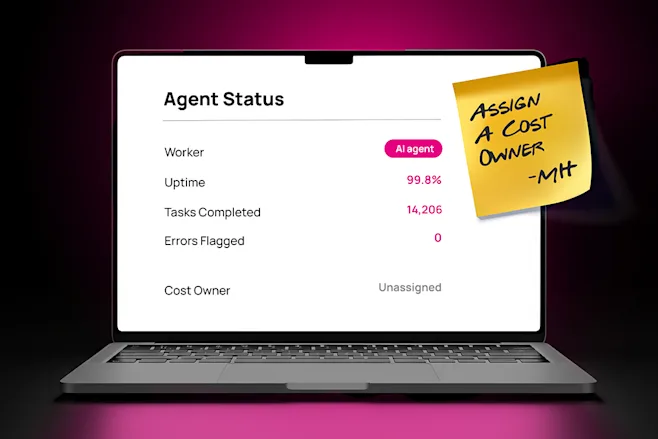
Congratulations — you just hired your next top performer. On the surface, it's sealed with a handshake, a celebration for both sides, and the union is full of promise. Behind the scenes, it's far more technical. Before your new employee starts, there's a mountain of paperwork and a wall of numbers. Salary, benefits, budget flows. There's insight into where the money is coming from, which department owns it and the expected ROI from the new hire.
Down the line, if those numbers start to drift, someone notices — because there's a clear owner of the employee relationship. Your exciting hire needs to hit certain benchmarks, certain KPIs, to justify what the business is paying them.
Now look at the AI agents working in your business. Whether anyone wants to acknowledge it, they are being paid. Every task they complete draws down tokens, and tokens are billed in dollars.
But that spend doesn't end up in any budget a compensation conversation would recognize. It runs through IT, filed next to server costs and software licenses, as if the thing consuming it were a subscription instead of a worker.
So here's the question almost nobody can answer: what does your agent workforce actually cost, and who owns that number? In a 2026 survey of business leaders at billion-dollar companies, only about a quarter said they had real-time visibility into what their AI actually costs to run — even as more than half were already deploying agents. The workforce is growing, and most companies can't see what that growth is costing them.
I've watched this pattern before, from the other side of it. I spent my last few years running an AI company, building agents alongside the businesses deploying them and watching most of those deployments come up short. The failures usually got blamed on the technology. The pattern underneath was almost always the same: nobody was accounting for what an agent actually demands from the business, cost included. The meter was running the whole time, and no one stopped to look.
I see it now from the buyer's chair, where agents are arriving faster than anyone can track: plenty of spend, no straight answer on where it's going or who owns it.
And agent spend compounds in a way other costs don't: the agent decides how much to spend as it works, and the bill shows up weeks later with nothing itemized.
Software Gets Provisioned. Workers Get Paid.
This is an important distinction. You provision software, but you pay a worker — and the two live in completely different parts of how a business thinks about money.
Provisioning asks one question: is the capacity there when we need it? It's a line item, fixed and forecastable, and it sits in infrastructure because that's its natural habitat.
Paying a worker asks a harder set of questions. What does this person cost, all in? What department carries that cost? What are we getting for the money, and is it a fair price? Those aren't infrastructure questions. They're workforce questions, and they belong to whoever manages the workforce.
An agent is billed like a SaaS subscription and behaves like a worker. We pay the agent in tokens — a form of currency. Treat that spend as provisioning and you get a number that's technically accurate and strategically useless: you know what you spent, but not what you spent it on, or whether it was worth it. Treat it as compensation and you can finally make the spend defensible.
What Compensation Means for an Agent
For a human worker, compensation isn't just the paycheck. It's the whole discipline of knowing what a worker costs, what department is responsible for the spend and whether they're earning their keep. Apply all three to agents.
Know the fully loaded cost. A salary is never the whole number. There's the base, but you also have to account for benefits, bonuses and quality of opportunity. There's the amount you're willing to spend when a worker needs help — the budgets that include reskilling, upskilling and performance support.
An agent takes exactly the same shape: not just the token rate that makes headlines, but every model call in a task, the retries, the orchestration, the storage and the monitoring underneath. Most organizations can quote the per-token price and have no idea what a single agent costs them in a month. The published rate tells you almost nothing. What the agent does with those tokens is where the real number lives.
Report the cost where the work happens. A human worker's cost is booked to the department they work in and the job they do. That's what makes labor reporting mean something: a leader can look at a function and see what it costs to run.
When agent spend is buried in IT, that visibility disappears. An agent doing collections work is a cost of collections, and it should show up there — next to the humans doing the same job. Blended labor cost, human and agent together, by department and by role, is the only picture that tells you what your workforce actually costs.
Weigh the cost against what it returns. No one funds payroll without asking whether the money is well spent. A salesperson's pay is read against the quota they carry; the cost only means something next to the production. Agent spend deserves the same reading. What does this agent cost for the work it actually does, and how does that compare to the value that work produces? That's the number leadership can act on — and it's the one almost nobody computes.
The Number Changes the Decision
Once the business can see what each agent costs against what it produces, the decisions get clearer and better informed than the ones being made today.
An agent that returns far more than it costs isn't a line item to trim. It's a proven performer, and the move it argues for is investment: put more work in front of it, or stand up more like it. An agent whose cost has quietly doubled against the same output is a signal that something changed — caught in a review, not an invoice. And an agent that costs more than it returns is a placement question before it's anything else: maybe the work belongs somewhere else, maybe there's a better-fit role, and sometimes the right answer is to let it go and bring in a better one.
These are the same kinds of decisions a business already makes about where to put its people and where to put its next dollar. They're only possible once someone has put a real number in front of the people who make them.
None of that happens while the spend is hiding in the wrong budget. You can't right-size a cost you can't see, and you can't invest with confidence in a return no one has measured.
HR and Finance Already Do This
Tracking what a worker costs and reporting it where the work happens isn't new territory — it's payroll and labor reporting, the discipline HR and finance have run together for as long as there have been employees. Extending it to agents is a natural expansion of scope, not a new function.
HR gives the business a clear view of its whole workforce and the framework to manage it. Sales, operations and finance make the calls — scaling, moving or replacing agents — the same way they make staffing decisions today. HR hands them the infrastructure to make those decisions well.
Without that infrastructure, agent compensation stays where it is now: an untracked cost in a technical budget, growing on its own, owned by no one, until the token bill comes due and everyone asks the same question — and no one has the answer. Most companies still can't produce one, even as the spend climbs and the agents multiply.
The Workforce Has Expanded
Part of it is now paid in tokens. The discipline that turned human labor from an untracked expense into something a business could actually manage is the same discipline this new worker needs. Point it at the agents, and you stop guessing what your workforce costs and start deciding what it's worth.
Next in this series: offboarding. Every worker's job eventually ends — and an agent's needs to end as cleanly as it began.

Related Posts

AI Agent Offboarding: The Exit Nobody Plans but Every Org Needs
Learn more about AI agent offboarding and why skipping it creates access risks, broken workflows, and lost institutional knowledge. Every agent exit needs a plan.
Read More
Employee Time Tracking: Close the Trust Gap With Self-Service Tools
Discover how better employee time tracking puts answers in employees' hands. Check punches, preview pay and clear alerts without an HR interruption.
Read More
Managing AI Agents: What to Do When Confidence Becomes a Risk
Learn more about managing AI agents and why confident, outdated decisions are harder to catch than low-confidence flags. Oversight, retraining, and accountability all matter.
Read More