Benefits Help for the Other 364 Days
Posted: 10/21/26
Each year, organizations invest more in employee benefits. But somewhere along the way, offering more benefits also turned into managing more vendors. Today, many employers are juggling half a dozen or more separate benefits providers, each with its own portal, website and login.
The employee is the one left to navigate all of it. They have medical with one carrier and dental with another. Retirement plans live somewhere else. A flexible spending account exists over here, vision over there and life insurance is bookmarked but hasn’t been opened since the day they signed up. When someone wants to actually use a benefit, they’re the one stuck playing detective just to find what they already have.
The Relationship Doesn’t End with Enrollment
The common assumption is that once open enrollment closes, the job is done. Employees made their choices; they know what they have and they know when to use it. And from there, it’s on to the next thing.
That’s where the value starts to fade. The moment enrollment closes, benefit details disappear into separate logins and portals nobody remembers. And by the time someone actually needs something—a covered screening, help with a claim, a question about their retirement match-finding it feels like too much work. Open enrollment is one day on the calendar. People live with their benefits every other day of the year.
A Benefit Only Works if Someone Can See It
You can continue to build more and more robust benefits packages, but if your employees can’t find them, that investment goes unused. A benefit nobody can find isn't a benefit—it’s just an expensive bill, for both the employer and the employee.
Only 10% of employees regularly engage with the health-focused benefits their employer offers, and 75% of employers admit their workforce underutilizes the benefits available to them.
Employers spend an average of more than $18,500 per employee on health benefits alone, yet only one in ten accurately understands the value of what they are offered.
The real problem isn't money. Employers are spending plenty. The gap is visibility. When people can't find the right resource at the right moment, they don’t engage with it. Coverage isn’t the barrier to adoption; visibility and understanding are.
The Cost of Doing Nothing
Leaving benefits buried has a real cost, and it’s paid every single day.
Flexible spending dollars keep expiring unused. Retirement contributions keep going unrealized. HR keeps fielding the same “what do I have for...?” questions. And employees keep paying for coverage they don't fully use, don't understand or barely remember signing up for.
The Benefits You Already Have, Finally in One Place
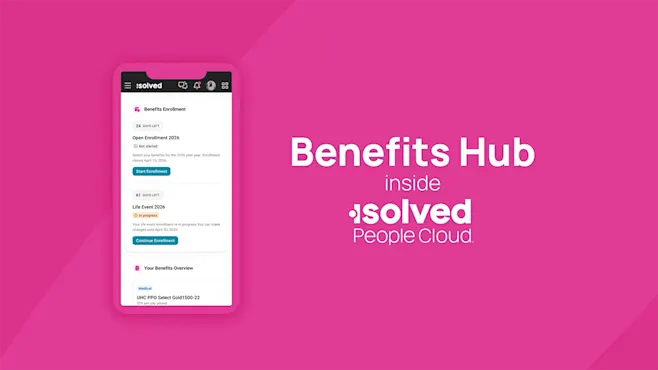
Benefits Hub is a quick access dashboard inside People Cloud™ that brings enrollment, benefits overview, life events, retirement and isolved’s Flex Benefits together in one place. It’s for employees, and for the HR leaders who support them, so no one has to go on a scavenger hunt to find the benefits they already have.
It meets employees where they already are, on the same platform they use to check a pay stub or a schedule. There’s no longer another login to remember or another site to bookmark. Employees can start or continue enrollment, see every benefit they carry and their cost per paycheck, check their retirement contributions and use the flex benefits experience to show a spending account card or request a reimbursement. And when life changes, such as having a new baby, they can start that update from their phone the moment it happens.
When employees can see their benefits, they stop calling HR to ask, “What do I have?” or “Am I covered for this?” They use what they have so the coverage you pay for stops going to waste and your team gets those hours back.
The Other 364 Days Start Here
Benefits Hub is built for the days after open enrollment closes. And this is just the beginning.
What comes next matters most for both sides: personalized nudges. The experience will keep growing to point employees toward the benefits they haven’t used fully. A preventative screening that is fully covered and past due. A reminder to use remaining FSA dollars before they expire at the end of the year. Well-timed prompts that reach people when they can act on them.
For employees, that turns benefits from something they hunt for into something that shows up when it matters, which makes preventative wellness simple. For employers, the benefits you already pay for get used instead of expiring unused.
The goal is to make wellness simple for your employees, and to make sure the benefits companies already pay for get used.
Outside of compensation, benefits are the second most important thing an employer provides. They deserve better than a login nobody opens. That’s what the other 364 days are about.

Author
Barry Gauch
Executive Vice President of Marketplace
Related Posts

Open Enrollment Without the Fire Drill
Read more about open enrollment tips that reduce employee confusion and HR inbox overload. Clear communication, easy comparisons, and the right tools make the difference.
Read More
Financial Literacy Month 2026: Turning Knowledge into Financial Confidence at Work
Learn how to build financial confidence at work. Financial literacy, tools and employer support come together to reduce stress and help employees make informed financial decisions.
Read More
Why Your 401(k) Plan Feels Harder to Manage Than It Should
Read how 401K plan management becomes complex with disconnected systems. Learn what causes administrative burden, compliance risk and inefficiencies in retirement plan operations.
Read More