An AI Agent’s First Review
Posted: 07/22/26
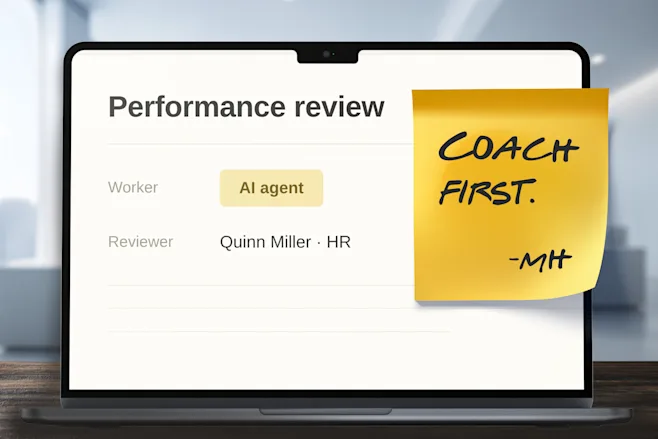
Ninety days into a new hire’s tenure, a manager sits down with the evidence — work samples, feedback from colleagues, results against the goals set on day one — and asks one simple question: is this working?
Ninety days into an AI agent’s tenure, nothing happens.
The agent is still off and running. Tickets get resolved, anomalies flagged, questions answered. And because nothing has broken, no one has thought to check in. In most organizations today, an agent can run for a year without a single structured evaluation of whether their work is any good.
That gap is a management failure. Managing workers is exactly what HR does.
From uptime to performance
Here’s the distinction that matters: monitoring tells you something is running. Performance management tells you it’s doing good work.
IT is excellent at the first part. Availability, latency, error rates, cost per task — these are in IT’s wheelhouse, and every serious deployment tracks them. But no HR leader would accept “showed up every day” as a performance review for a person. Attendance is the floor. The review asks about quality, judgment and outcomes.
Agents need that same scrutiny, because agents don’t fail the way software fails. Software breaks loudly — an error, an outage, a broken sequence. Workers underperform quietly. Judgment slips. Routine tasks get put off and resurface later as fire drills. Catching that early is the whole reason performance reviews exist.
That’s the point: software fails loudly, and agents fail like workers — quietly, and only to someone who’s looking. The industry already has a word for it, drift, and it’s exactly what performance management was invented to catch: the slow divergence between what someone was hired to do and what they’re actually doing. Drift never shows up on an uptime dashboard. It’s obvious the second a qualified person reviews the work. Leave an agent unreviewed and their good work is quietly on its way to becoming drift.
The review cycle you already run
Last time, I walked through onboarding an agent. Performance management is the same story: you already know how to do this. Every part of a mature review program has a direct agent equivalent.
Expectations set up front. A review only works if the goals were set at the start — the same for an agent as for a person. Their success criteria, like accuracy thresholds, escalation behavior and tone standards, should be written down the day they’re onboarded, so a review has something to measure against later. If you can’t say what good work looks like for an agent, you haven’t finished hiring them.
Grade the real work. Strong managers go to the source: the actual output, sampled on a schedule. For an agent, pull a fixed number of interactions each month and have a qualified person grade them against the standard. It has to be a random sample, because the failures that matter are the ones nobody has complained about yet.
A regular cadence. Annual reviews already move too slowly for people. They’re far too slow for an agent, whose world changes every time a policy updates, a system integrates or the business shifts underneath them. Once a month is a reasonable starting rhythm — a standing check-in, short and structured, exactly like a manager’s one-on-one.
A named reviewer. Every employee has a manager. Every agent needs one too: a specific person accountable for their performance, with the authority to adjust their scope and the obligation to review their work. “The IT team” is not a manager, and neither is “the vendor.” Accountability that belongs to everyone belongs to no one.
A record. Human performance history lives in a system of record — goals, reviews, ratings, actions taken. Agent performance history should live the same way, alongside the rest of your workforce records. When an auditor, a regulator or your own board asks how you supervise your AI workforce, “we’d have to check the logs” is not an answer. A performance file is.
Coach before you cut
This is where the management mindset matters most. When a person underperforms at ninety days, you diagnose before you ever think about showing them the door. Were the expectations clear? Did the role change? Do they need training, or a narrower remit?
The same discipline applies to an agent, and it’s worth more than most leaders expect. An underperforming agent is rarely a failed agent. Usually their knowledge has gone stale, their instructions have quietly fallen out of date or their scope crept past what they were built to handle. Those are coaching problems: refresh the knowledge, tighten the instructions and right-size the role. Decommissioning is the last resort — the agent equivalent of termination, reached only after documented underperformance and honest attempts to fix it.
Skip this step and you end up in a costly loop: deploy, abandon, redeploy and repeat. Gartner expects more than 40% of agentic AI projects to be scrapped by the end of 2027, and one reason is exactly this — organizations that never built the discipline to tell a fixable agent from a failed one. It’s the workforce equivalent of firing every struggling employee and paying to recruit the replacement, over and over, without ever asking why the role keeps breaking the person in it.
Why this lands on HR’s desk
Performance management is an HR discipline — it always has been. The only new thing is the kind of worker it now applies to.
The hard parts of a review program were never the metrics. They were the human parts: setting fair expectations, separating evidence from anecdote and knowing when to coach and when to cut. HR has spent decades getting good at exactly that. A CHRO or Chief People Officer who extends that machinery to the agent workforce is simply doing their job — now for the full workforce they govern.
The agents are already working. The only question left is whether anyone is managing them.
Next in this series: growth and development — because an agent that passes its review is only getting started.

Related Posts

AI Agent Offboarding: The Exit Nobody Plans but Every Org Needs
Learn more about AI agent offboarding and why skipping it creates access risks, broken workflows, and lost institutional knowledge. Every agent exit needs a plan.
Read More
Employee Time Tracking: Close the Trust Gap With Self-Service Tools
Discover how better employee time tracking puts answers in employees' hands. Check punches, preview pay and clear alerts without an HR interruption.
Read More
AI Agent Costs: Why Token Spend Belongs in Your Workforce Budget
Explore AI agent costs and why most businesses are tracking them wrong. Agent spend belongs in workforce budgets, not IT — alongside the humans doing the same work.
Read More