AI Won't Steal HR's Job, but It Could Steal HR's Moment
Posted: 10/21/26
Walk the floor at HR Tech and count how many booths are selling AI agents. You’ll see agents that screen candidates, agents that answer benefits questions and agents that notify HR of payroll errors. Now count how many are talking about what happens after the sale: who manages those agents, who’s responsible for them and who’s keeping track of them. The count isn’t close.
That blind spot is about to grow much larger. Last year, the average Fortune 500 company was running fewer than 15 AI agents. By 2028, that number is projected to pass 150,000. The workforce of people and agents is here, and the organizations that shift now will be the ones that lead the future.
A Lot of AI Is Falling Short
Most AI hasn’t lived up to expectations. For many companies, AI is still a promise on its way to becoming a return.
When you dig into why, the same three reasons come up again and again. The first is bad data: we feed systems fragmented, messy information and expect a perfect output. The second is a focus on science projects: we chase the impressive demo instead of the real workflow. The third is trying to make AI agents work the way humans do, forcing them into processes that were built for people.
Companies Bought It, and Deployed It, Like Software
Most companies bought AI the way they buy any other software: a business case, an RFP, demos, licenses, seats, a security review.
And then companies deployed AI just like software, too. They handed their agents to IT, got them provisioned and configured, then measured success by token usage and how many employees logged in. IT kept them secure and running, applied patches and upgraded when the time was right. That’s how we’ve always managed software after go-live.
And notice who usually isn’t in the room: HR.
AI Isn’t Just Software
Prior to isolved, I worked in HCM and then became the CEO of an AI company. Leading it showed me firsthand that agents behave less like software and more like workers. That points to a fourth reason AI doesn’t deliver: we keep treating AI as software.
Traditional software is deterministic; AI isn’t. It has many of the characteristics of a human worker, and it needs many of the same things.
HR should have a voice in the room when companies discuss bringing an AI agent on. But the real work starts after the purchase. Agents need to be onboarded. They need to be trained on your data. They need a manager and a mentor, so there’s a human available when they need help. They need KPIs, and their performance needs to be monitored to make sure they’re doing the job they were assigned. They need to be paid in tokens. They need to be upskilled as the work changes. And eventually, they need to be offboarded.
What does that sound like? Not software. A workforce.
That 150,000 AI agent projection comes from Gartner guidance written for CIOs and IT leaders. The same research found that only 13% of organizations think they have the right AI agent governance in place. Once again, HR isn’t in the room.
Someone Must Support This New Workforce
Right now, nobody owns the work of managing AI agents, and that won’t last long. Companies will have to decide who assumes the responsibility and seizes the opportunity. There are four options:
Build a brand-new function, duplicating something that already exists with a new name attached.
Hand it to IT, a function that’s excellent at managing the machine but was never set up to manage the worker.
Let every department run its own agents its own way, and nobody sees the whole picture.
HR steps up, because HR already manages the workforce. Supporting a workforce from hire to retire is what HR has spent decades perfecting.
The first three options involve splitting people and agents into two separate workforces when they should be working as one. The fourth path is the only way to keep AI agents and people as one workforce, and it starts with HR.
This doesn’t require HR to get out of its lane, and nobody expects HR to do IT’s job. IT keeps AI agents secure and running. HR does for agents what it already does so well for people: a similar lifecycle and the same expertise, aimed at a different kind of worker.
HR Is Ready
The introduction of AI agents into the workforce is one of the biggest workforce changes since the Industrial Revolution. And next comes physical AI: machines that work alongside us. It all adds up to a fundamental shift in how we work and how we think about the workforce. And it’s not just an IT project.
HR spent decades climbing out of spreadsheets and into strategy. AI could send it right back, with a new set of spreadsheets tracking agents nobody officially owns. Or this could be the moment that HR has been waiting for. In more than 30 years in this industry, I’ve never seen a bigger opportunity for HR. HR has been ready for years. Now it gets to prove it.
What You Need to Be Successful
To support this new workforce, you need a single system of record for all of it: human workers and AI agents, side by side. It’s the natural evolution of human capital management. We call it Workforce Capital Management, or WCM.
Throughout my career, my goal has been helping small and mid-sized businesses compete with much bigger organizations by giving them the same tools. They often lack the time and resources to build a system like this themselves, and now they won’t have to.
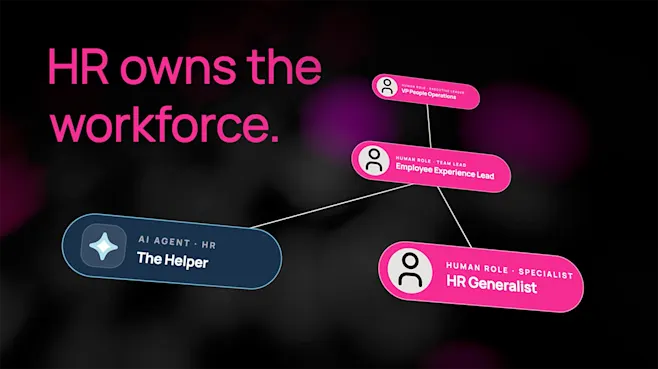
The first step is simpler than you might think. Most companies can’t tell you exactly how many AI agents they have, where those agents are working or who owns them. The majority aren’t cataloging them today, but HR teams can start now. Find every agent working in your organization. Put each one on the org chart. Give every agent a role and a manager, so no agent is left orphaned when someone changes jobs.
That’s where isolved starts today, with Agent View. In the months ahead, we’ll extend Workforce Capital Management across the rest of the AI agent lifecycle: onboarding, training, performance, cost, all the way through offboarding. Everything you already do for your people, you’ll be able to do for your agents.
Don’t Let AI Steal HR’s Moment
Agents are joining the workforce, and how well organizations manage them will shape the next decade of work. AI isn’t here to steal HR’s job. But it could steal HR’s moment, if HR lets someone else claim it.
Don’t let it. This is HR’s moment, and isolved is here to help you make the most of it.
Join us at HR Tech booth #5809 to see Workforce Capital Management in action.

Related Posts

An AI Agent’s First Day
Learn how AI agent governance starts with proper onboarding. Giving agents an identity, a manager, set permissions, and supervision drives real accountability.
Read More
Workforce Capital Management: A Category We're Built to Own
Learn more about workforce capital management and what it means for HR. Explore how AI-powered agents and platform integrations are redefining what an HCM system can own and deliver
Read More
AI Agents for HR: Putting the Human Back in HR Work
Learn more about AI agents for HR that free your team from repetitive tasks. Six purpose-built agents take on payroll, onboarding, employee questions and compliance.
Read More