The Agent Nobody Developed
Posted: 08/26/26
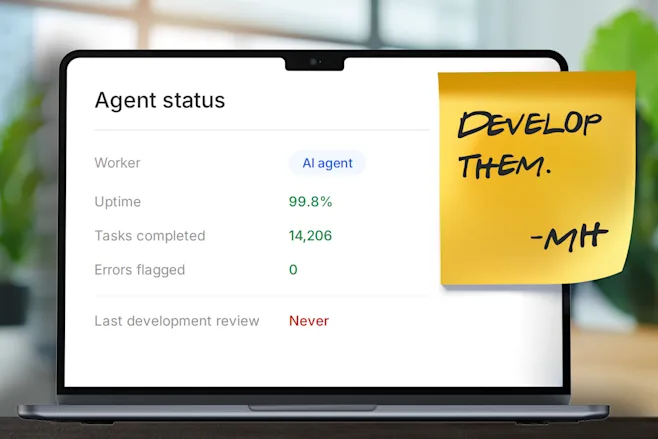
Think about the last performance review you approved and then forgot about. The employee was fine; competent, reliable, no red flags. You signed off, moved on and assumed the rest would take care of itself. A year later they're doing the same work, the same way, with the same gaps you noticed but never pressed on because nothing was broken enough to act.
That's not an employee problem; it's a development failure — and it's one of the most expensive problems an organization can ignore, because it compounds silently.
I’ve walked into organizations where tenured employees had gone years without a real development conversation. Not because anyone was failing — because no one was. They were hitting their numbers, doing exactly what they were asked to do three years ago. The business had moved. Nobody had helped them move with it. By the time leadership noticed, it wasn’t a coaching conversation anymore. It was a restructuring. The cost of that neglect wasn’t visible on any dashboard until it was the only thing on the dashboard.
The agent workforce has the same problem. And almost no one has a process to fix it.
I've written about what it takes to onboard an AI agent properly, and what a real performance review looks like for agents. Both assume that someone takes the next step after the review ends. Most organizations simply aren't. The agents that passed their first review six months ago are running on six-month-old assumptions. Nobody has touched them — because nobody has a process for what comes next.
Software gets updated. Workers get developed.
An update pushes new code to a system. Development builds capability in a worker. The distinction matters because updates are automatic and development isn't — it requires someone to decide that a worker is ready to grow, design what that growth looks like and hold them accountable to it. Organizations apply this discipline to their human workforce as a matter of course. Almost none of them apply it to agents.
The result is predictable. An agent deployed six months ago knows the policies that existed at deployment. They cover the scope that fit the business half a year ago. In a business that's changing, and every business is changing, those agents don't offer stability. They drift. And drift in an agent doesn't look like failure, right up until it does.
What development means for an agent
For a human worker, development has a recognizable shape: refresh their knowledge, expand their responsibilities as trust grows and coach them based on prior performance.
The same three things apply to agents.
Knowledge refresh
Policies, products and regulations are all constantly changing. Employees pick this up in team meetings, messages and conversations in the hallway. Agents only understand these changes if someone explicitly tells them. Without that, the agent operates on yesterday's facts — and nobody knows it until something goes wrong.
Stale information compounds faster than most organizations expect.
Independent production testing across 50,000 live sessions found that agents without structured memory updates hit roughly 49% effective recall accuracy after thirty days as stale data accumulates. Half of what the agent knows becomes unreliable within a month. InsightFinder documented a fraud detection model at a major U.S. credit card company whose accuracy drifted for weeks while passing every traditional health check — before the degradation surfaced in outcomes. The agent wasn't deeply broken. The information was just out of date.
The same pattern shows up in any workflow where an agent touches real decisions. The monitoring dashboard says the agent is working but it doesn't say what the agent is getting wrong.
Scope expansion
No organization promotes employees automatically. A manager evaluates performance, decides an employee is ready and deliberately expands the role. Expanding an agent's scope should work the same way. Deciding when an agent is ready to handle more is a managerial decision, not a technical one.
An agent that earns expanded scope should truly earn it. That means a supervisor making a deliberate call, the same way a manager makes a deliberate decision when they hand someone new responsibilities. HR already owns that process for people. The agent workforce needs the same ownership.
Instruction refinement
Every performance review surfaces gaps. For a human worker, the next step is a coaching conversation, where a manager sits down and says: here's what I saw, here's what needs to change and here's what success looks like going forward.
Agents need the same follow-through. It starts by going back through the outputs from the review period — not to confirm the agent was working, but to understand how they handled the moments they weren’t built for. Where did they guess when they should have stopped and asked? Where did they get something right in isolation and wrong in context?
The answers to those questions become the work: fixing the instructions that led them there, closing the gaps, testing the changes before putting them back in front of real decisions. And then a check-in — not at the next formal review, but before it. Because no good manager coaches someone on a Tuesday and waits six months to see if it stuck.
The organizations doing this well treat instruction refinement as a recurring discipline, not a one-time fix. The ones that aren't are still running agents with the same problems the last review found.
Develop before you replace
An agent that's falling short isn't necessarily a failed agent. They may just be under-developed. The distinction matters because one gets offboarded and the other gets developed. Organizations that can't tell the difference will offboard agents they should have developed and keep running agents they should have replaced.
Before you replace an agent, you should be able to answer three questions.
Did they have current information to work with?
Were they in the right role for the right scope of work?
Did anyone actually go back and fix what the review surfaced?
If the answer to any of those is no, you don't have a failed agent. You have one that nobody developed.
Sometimes the agent really does need to be offboarded. But organizations that skip those three questions and default to replacement are leaving value on the floor — and picking up the full deployment cost all over again.
HR already built this
HR already runs learning and development for the human workforce — learning paths, coaching cadences and accountability structures. The agent workforce needs the same function pointed at a new kind of worker. Without it, development is ad hoc: someone in IT pushes an update when a user complains, and what follows has no record, cadence or owner. That’s not development; it’s maintenance without a plan.
Development is what separates an agent that keeps working from one that slowly falls behind. The discipline already exists — HR built it. The workforce just got bigger, and the same investment that turned the human workforce from tactical to strategic can do the same for agents.
Next in this series: management and supervision. An agent you’ve developed still needs someone answering for them.

Related Posts

AI Won’t Steal HR’s Job, but It Could Steal HR's Moment
Learn more about HR and AI agents and why HR is best positioned to manage them across the full employee lifecycle. Ownership, oversight, and accountability all start with HR.
Read More
The Questions HR Never Has to Answer Again
Learn more about an AI agent for employee self-service that answers routine HR questions instantly. Pay, benefits, time off, and contacts handled so HR time goes further.
Read More
The Bar for Payroll Just Moved
Learn more about AI payroll error correction that goes beyond detection to preparing fixes with human approval. Accuracy, accountability, and control stay with your team.
Read More