The Hire Nobody Made
Posted: 08/05/26
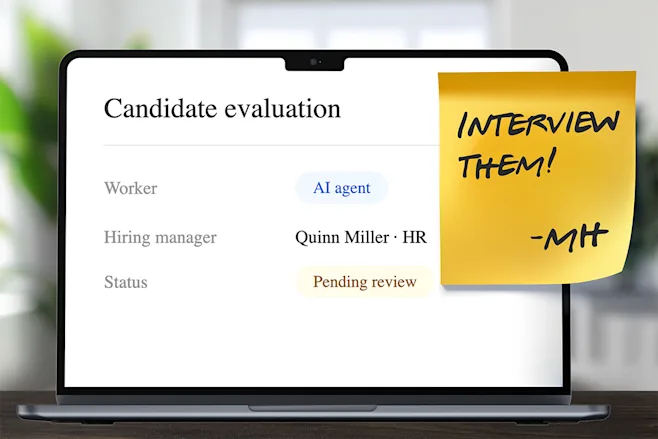
Every client conversation I’ve had in the last year has some version of the same admission: we have agents running in our business and no one knows who launched them.
That’s not a technology deployment; it’s an unmanaged hire.
Every serious organization has a hiring process. It typically looks like this: a role is defined, a pool of candidates is evaluated against clear standards and a decision maker is accountable for the outcome. When it works, the right person ends up in the right role. When it doesn't, the cost shows up for months — in wasted onboarding, productivity gaps and the quiet damage of a bad fit. SHRM puts the price of replacing a single employee at between 50 and 200 percent of their annual salary.
Now look at how most organizations acquire AI agents. Someone in IT evaluates a vendor, someone in a business unit says that looks useful and the agent gets deployed. There’s no job description, no candidate evaluation and no deliberate decision about whether this agent belongs in this workflow with these people handling these stakes. The agent just shows up one day, already working.
I've written about what it takes to onboard an AI agent properly, and what a real performance review looks like. All of that starts with a hiring decision most organizations are skipping entirely.
The Job Description Comes First
No competent hiring manager would start interviewing candidates before writing the job description. That is exactly what happens with agents every day. A team sees a demo and jumps to deployment. This is the equivalent of hiring someone because their résumé looked interesting, without ever defining what they will actually do.
The job description for an agent answers the same questions it answers for a person: what this role is responsible for, what decisions they make and what they escalate, who they work alongside and what those employees need from the agent. It also clearly states what success looks like at 30, 60 and 90 days. Most importantly, it makes clear where the boundaries are.
Writing that down before evaluating a single vendor imposes a clarity most agent deployments skip. It separates what the organization needs from what the technology can do. The last thing anyone wants is a brilliant tool performing the wrong job.
Evaluate Candidates, Not Just Capabilities
A résumé tells you what someone has done in the past and likely what they can do in the future. An interview tells you whether that person is a good fit for your organization. Agent selection needs both.
The capabilities assessment is the part most organizations already do reasonably well. This step tells you what this agent can handle, how accurate they are, what the technical requirements look like. That is the résumé. Stopping there is like hiring a developer solely because they know the right programming language, without asking whether they can work on a team or operate within the company standards.
The interview, the part almost no one does, is the contextual evaluation. How does this agent behave when they encounter a situation outside their training? Do they escalate, or do they make it up as they go? How do they handle sensitive employee data? What happens when they are wrong — does the error surface quickly, or does it compound?
These are judgment questions, the same kind HR weighs when deciding whether a candidate is the right fit for a role, not merely qualified for it.
Reference checks deserve the same diligence. Where has this agent been deployed before, and what actually happened? The failures worth knowing about aren’t the ones in the vendor documentation: they’re the ones that surfaced in production, in the use cases the designers never anticipated. That information exists. The question is whether anyone is asking for it, or whether the organization is taking the agent's résumé at its word.
Culture and Ownership
An agent that technically works but clashes with how the organization operates is a bad hire. Culture in this context is concrete: an agent's communication style has to match what employees and customers expect. Their decision-making logic needs to align with the organization's risk tolerance. An agent should handle ambiguity the way the organization does, whether that be escalating when uncertain, defaulting to the conservative answer or asking for clarification.
An agent making autonomous decisions inside an organization that requires explicit human approval is a governance mismatch. These are misfit puzzle pieces, and they are exactly what a structured hiring process catches before the offer letter goes out.
Which brings the harder question: who owns the decision? Right now, agent hiring typically lives in IT or procurement. HR is not at the table, which means the function responsible for workforce planning, role design, performance standards, compliance and employee experience has no voice in a decision that puts a new worker into the workforce.
The CHRO or Chief People Officer should own the agent hiring framework the same way they own the human hiring framework. They’re not currently in the weeds of making every hire, but they are setting the standards, designing the process and ensuring every agent brought into the organization is a good fit. HR leaders provide the guardrails and hiring managers make the final call.
At Salesforce, the Chief People Officer and CIO operate as joint authority on AI deployment — meeting regularly, running a shared steering process. They evaluate every AI tool for technical fit, workforce impact, adoption and ethical risk. To date, they’ve deployed over 50 AI tools internally across their organization. It’s not a coincidence that the company has staked its strategy on humans and agents working side by side. It is a model replicable by any organization willing to put the right two leaders in the same room.
The Cost of a Bad Agent Hire
Organizations have gotten sophisticated about measuring the cost of a bad human hire; the recruiting spend, the lost productivity, the team disruption. The cost of a bad agent hire follows the same logic, with one difference that changes everything: an agent's mistakes scale instantly.
A person who is a poor fit affects their team, their projects and their specific corner of the organization. An agent that is a poor fit affects every interaction they touch, simultaneously, from the moment they go live. While a bad human hire gives one employee the wrong answer, a bad agent hire gives a thousand employees the wrong answer in the same afternoon.
That asymmetry makes the selection decision more consequential and builds the case for a more structured, rigorous process. Right now, most agents are walking in the door without an interview. The process already exists — HR built it. It's time to point it at a new kind of worker.

Related Posts

AI Won’t Steal HR’s Job, but It Could Steal HR's Moment
Learn more about HR and AI agents and why HR is best positioned to manage them across the full employee lifecycle. Ownership, oversight, and accountability all start with HR.
Read More
The Questions HR Never Has to Answer Again
Learn more about an AI agent for employee self-service that answers routine HR questions instantly. Pay, benefits, time off, and contacts handled so HR time goes further.
Read More
The Bar for Payroll Just Moved
Learn more about AI payroll error correction that goes beyond detection to preparing fixes with human approval. Accuracy, accountability, and control stay with your team.
Read More